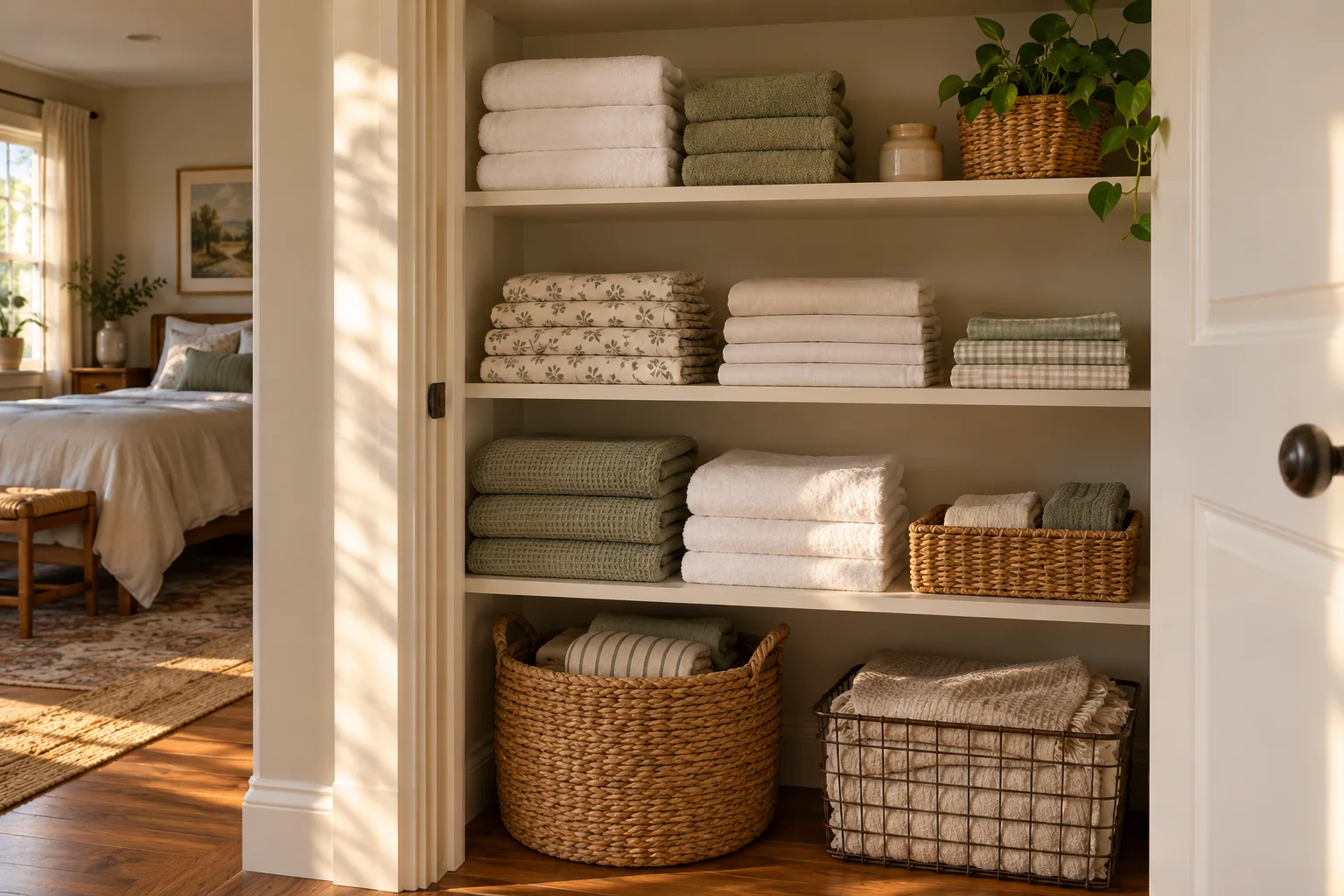
Organize a linen closet by household use, not by an idealized photo: edit damaged or unused pieces, keep complete sheet sets together, give daily towels the easiest shelf, and leave enough open space to put clean laundry away.
A closet can look perfect immediately after folding and still fail next laundry day. The durable version fits the shelf dimensions, the volume of linens you actually keep, and the way everyone in the household returns things. Begin with a small inventory before buying containers.
Begin with the most useful changes
Empty one shelf at a time. Sort towels, sheet sets, blankets, guest linens, and cleaning cloths separately. Check condition and size, and decide what has a realistic place in the household.
Choose a repeatable fold rather than a perfect display fold. Keep each sheet set together using a breathable container or a matching pillowcase when the fabric and care instructions permit it.
Inventory what the household really uses
Empty one shelf at a time. Sort towels, sheet sets, blankets, guest linens, and cleaning cloths separately. Check condition and size, and decide what has a realistic place in the household.
Keep hygiene and fabric-care needs in view. Launder stored linens according to their labels, and do not place clean bedding beside household chemicals or damp items.
Start with the linen you actually use
Open the closet and name its main job before moving a single shelf. Is it primarily for bath towels, bedding, guest linens, or a mix of household supplies? A closet that serves every room needs different zones from a cupboard beside one bathroom. Walk through the household's ordinary week: where do clean towels go, where are sheets changed, and which items are reached by children or guests? This brief inventory keeps the project grounded in use instead of in a photograph of perfectly matching baskets.
Remove everything and sort it on a clean bed or table. Group bath towels, hand towels, washcloths, sheet sets, blankets, table linens, and cleaning supplies separately. Check each item's condition. A frayed towel can become a cleaning rag, but it should not be stored among the towels guests are meant to use. Stained sheets that no longer fit any mattress take valuable space. Dispose of damaged items responsibly and donate only pieces that are clean and usable according to a local organization's rules.
Count demand before setting a limit
There is no universal number of towels or sheet sets that every household needs. A home with frequent visitors, small children, or a long laundry interval may need more backup than a home with a weekly wash routine. Count how many items are in active rotation, how many spare sets prevent a practical shortage, and which are kept solely out of habit. Write that target down. The closet should hold the chosen supply comfortably, with enough air and hand room to remove one item without dislodging the rest.
Measure the usable width, depth, and height of each shelf after it is empty. Include door clearance, hinges, and any pipes or access panels. Deep shelves may hide a second row that becomes a forgotten pile. A shallow bin or a vertical divider may make more sense than a large box that requires removing everything in front. Before buying organizers, test the proposed zones with the actual linen. Fold one towel and one sheet set, then see how many fit in a stable stack.
Clean and check the storage space
Wipe shelves using a product appropriate for their surface and let them dry fully before restocking. Check for a leak, condensation, damp smell, or discoloration. Fabric stored against moisture may smell stale even if it was clean when folded. A musty closet needs its moisture source investigated, not hidden with scented paper. Confirm the door opens freely and that stored items do not block ventilation, plumbing access, or an electrical panel.
Separate cleaners from fabric where possible. If household chemicals must share this closet, keep them in their original containers, follow label storage directions, and use a dedicated contained zone away from towels and children's reach. Never transfer a cleaner into an unmarked bottle or place it above linens where a leak could drip onto them. The storage plan has to work for safety as well as appearance.
Assign shelves by frequency and weight
Put daily towels and the most-used bedding at an easy height. Bulky blankets can use a higher shelf if they can be lifted safely; heavy items should not be stacked where they may fall.
Measure shelf width, depth, and door clearance before choosing bins. A little empty space is useful because fresh laundry needs somewhere to go.
Give each shelf a clear role
Reserve the easiest-to-reach shelf for the linen used most often. A lower shelf might hold family bath towels; a middle shelf might hold the current bedroom's spare sheets. Rare guest blankets can go higher, provided the weight is manageable and the shelf is secure. Heavy items should not be stored where someone must lift them above shoulder height. If children get their own towels, place that stack at a height they can use without climbing.
Assign each category a bounded space rather than allowing it to spread wherever there is a gap. A shelf for bath towels, a labeled bin for washcloths, and a separate zone for guest sets create visible limits. If a category overflows its zone, review the quantity or choose a larger zone deliberately. A label does not solve an inventory that exceeds the closet's capacity. Leave a little open space so hands can lift a stack without dragging the one next to it.
Keep sheet sets together
Matching fitted sheets, flat sheets, and pillowcases can become scattered when they are stacked by item type. Fold each set and place its pieces together, either in one pillowcase or in a labeled breathable bin. Choose the method that household members can repeat. A pillowcase bundle works when the fabric is easy to identify and there are few beds; a divided shelf may work better when several mattress sizes look alike.
Label by bed size and room, especially if twin, queen, and deep-pocket sets share a shelf. Do not rely on color alone: similar white sheets can differ in size or pocket depth. Keep only the number of backups that matches your laundry cycle and guest pattern. Store a rarely used seasonal set separately from the everyday rotation so it does not interrupt the search for tonight's bedding.
Fold for the space you have
Uniform folding is useful because it makes stacks stable and quantities visible, but it need not be elaborate. Fold towels to the depth of the shelf so the front edge aligns; this reduces the temptation to push them into an untidy rear pile. For deep shelves, a short front stack and a labeled reserve behind it may work if you can still see and reach the reserve. Alternatively, use a low-sided bin that slides forward without scraping the shelf.
Avoid stacking towels so high that the top leans into the door. A stack that collapses each time a towel is taken will never stay organized. Use vertical dividers for narrow shelves or separate bins for small washcloths and pillowcases. Choose breathable materials if the closet has limited airflow, and wash fabric bins occasionally because they can collect dust. Organizers should reduce the number of motions needed to put linen away.
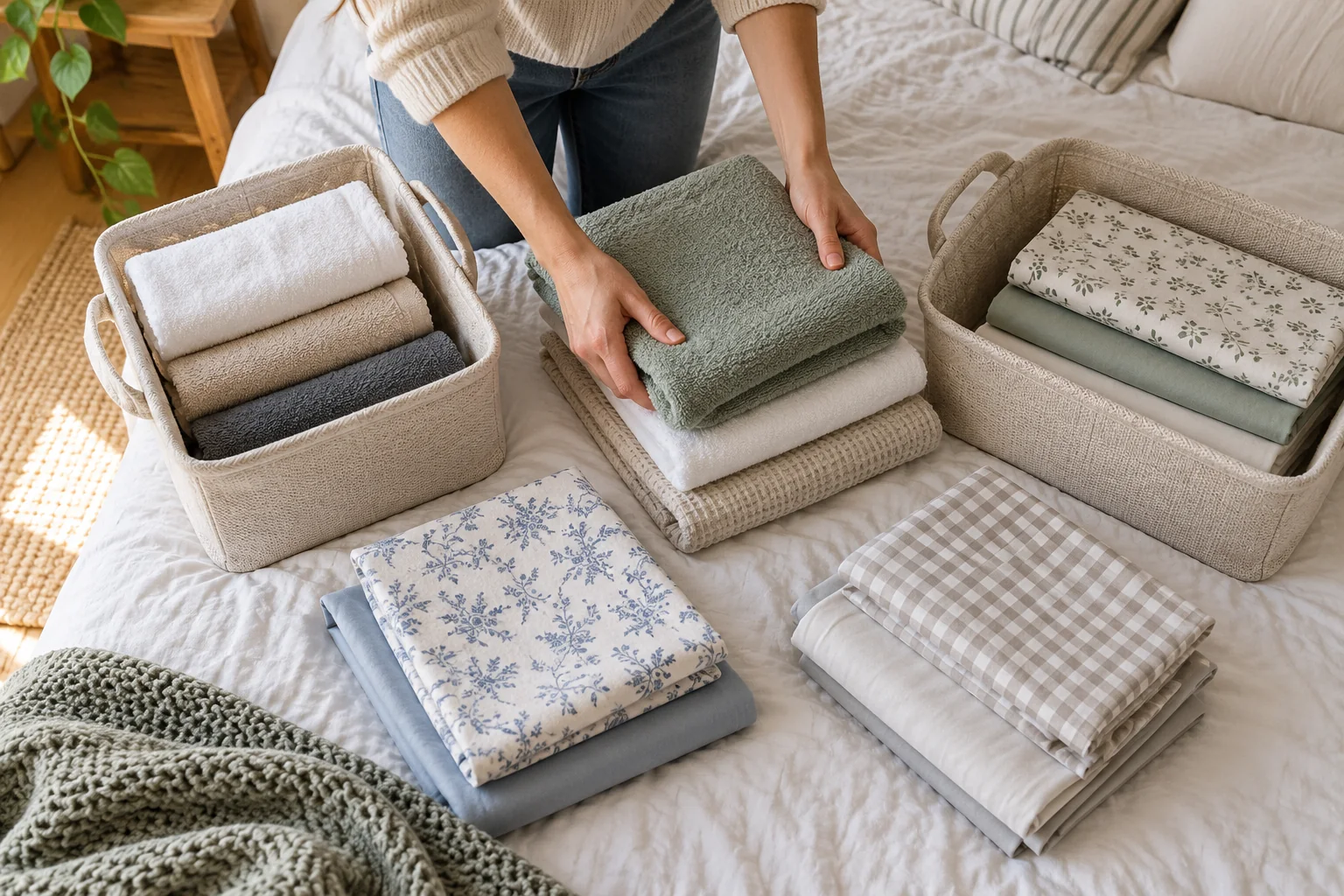
Fold and store complete sets
Choose a repeatable fold rather than a perfect display fold. Keep each sheet set together using a breathable container or a matching pillowcase when the fabric and care instructions permit it.
Do not seal damp fabric in a plastic bin. If the closet smells musty or the wall feels damp, resolve the moisture issue before restocking.
Decide where containers help
A container earns its place when it corrals small pieces, protects a rarely used set, or makes a deep shelf accessible. It is unnecessary for a stable stack of bath towels on an open shelf. Clear or low-sided bins let you see contents; opaque baskets need accurate labels and regular checks. Measure before purchasing, leaving clearance for fingers and for the door. A tight row of beautiful baskets can make a closet less usable if none can be pulled out easily.
Put small, loose items such as spare pillowcases, washcloths, and travel towels in separate containers. Resist a single miscellaneous basket. It quickly becomes a place where unmatched items go to disappear. If the closet also holds paper goods, give them their own zone so packages do not crush fabric. Avoid scented sachets where someone has fragrance sensitivities; clean, fully dry linen and a dry cupboard matter more than perfume.
Build a return path from laundry day
The organization survives only if putting items away is simple. Ask the person who most often folds laundry to place one load into the proposed layout. Can they identify the correct shelf without opening three bins? Can they add fresh towels to the back or bottom so older clean towels are used first, without rebuilding a tower? If the answer is no, adjust the system. A practical return path is more valuable than a perfectly symmetrical first photograph.
Use labels that state the content people search for, such as Queen Sheets or Guest Towels. If a label gets ignored, its category may be too abstract. Household members may say hand towels, not bath accessories. Place a small laundry or repair basket nearby only if there is room; do not let a temporary holding basket become permanent storage. Make a rule for loose items: match, mend, donate, or discard them during the next laundry cycle.
Create a reset that takes minutes
Label zones plainly if several people use the closet. Put clean items behind or beneath older ones where that helps rotation, and keep a small overflow rule rather than buying more bins whenever a stack grows.
After two laundry cycles, see which shelf becomes messy first. Move that category or change the container instead of expecting everyone to remember a complicated system.
Test the closet in ordinary use
After a week, look at the shelf where people have made a new pile. That pile is information. Perhaps the towel category is too far from the bathroom, or the sheet labels are hard to read. Move the frequent-use item to the easier position before buying another container. Check whether anyone had to climb, pull out a heavy bin, or search through multiple sizes. A useful system shortens those steps.
After a month, revisit the quantities. If one stack remains untouched while another runs out, the shelf allocation may be wrong. If a bin stays empty, remove it and reclaim the space. If dampness or odor appears, remove the fabric and investigate the cause before restocking. Organization cannot compensate for a building moisture problem, and washable linen should be laundered and completely dried after exposure.
Maintain a small reset routine
At the end of a laundry session, straighten the active stacks and return stray pieces to their labeled home. A five-minute reset is enough when categories and quantities are clear. During a seasonal change, check mattress sizes, discard threadbare pieces, and compare the backup supply with current household needs. The goal is not to keep every folded edge identical. It is to find clean linen promptly and return it easily.
If the closet serves several people, share the layout in simple terms: everyday towels on the middle shelf, guest sets above, washcloths in the left bin. Avoid rules that require remembering a complex color system. The best setup is visible, repeatable, and forgiving when a load is folded differently. Leave space for the inevitable odd item, but give it a decision date instead of an indefinite corner.
Use what the audit taught you
The first edit often reveals that the closet was storing too many unused sets or doing too many jobs. Keep those observations for future purchases. Measure the space before replacing organizers, choose washable materials where they will collect dust, and do not add shelving until you know what needs a home. A well-planned linen closet is a quiet piece of daily infrastructure: clean fabric stays dry, the right size is easy to find, and the next load has a place to land.
Review the room in use
A room makeover should make ordinary routines easier. Spend a day noticing where items accumulate, where people bump into each other, and which surface is hard to reach or clean. Record one or two friction points before choosing finishes. After the first change, use the room normally for a few days. A clearer counter or brighter corner may help more than a dramatic new item that consumes floor space. Keep the changes that improve movement and access, not merely the photograph.
Measure before buying furniture, storage, or mirrors. Leave enough clearance for doors, drawers, and people to move. Check the installation requirements for anything mounted on a wall, including the wall type and hidden services. A lightweight decorative change and a heavy wall cabinet are different projects. If the room has water or electrical risks, stop at planning and use qualified help for the technical work.
Build a layered result
Most rooms benefit from several modest choices working together: light, storage, surface color, and a clear path through the space. Evaluate each layer against the same goal. If a new lamp creates glare, adjust its position rather than adding another. If storage makes the room feel crowded, remove or relocate items before buying more containers. Small revisions are part of the process, not evidence that the first plan failed.
Keep product details and paint colors in a home note. Photograph the room in its usual light after each meaningful change. That record helps you decide whether the next purchase is necessary. A successful makeover is not the most elaborate one; it is a room that feels more comfortable and functions better on an ordinary day.
Frequently asked questions
How many towel sets should I keep?
Keep enough for the household's actual laundry rhythm and guests, then make the number fit safely in the available space.
Should sheets go in plastic bins?
Use storage compatible with the fabric and only when items are fully dry; avoid sealing in moisture.
How do I stop stacks from falling over?
Reduce stack height, use a suitably sized shelf divider or basket, and place frequently used items at easy reach.